



The creative world is buzzing—and not everyone is excited.
Anthropic has rolled out new capabilities in its Claude AI that let users generate designs, layouts, and visual content just by typing prompts. No complex tools, no long tutorials—just describe what you want, and it appears.
And that’s where the tension starts.
Because this move places Claude directly in competition with industry staples like Figma and Adobe platforms designers have relied on for years. For many creatives, this feels less like innovation and more like disruption.
Claude isn’t coming alone either. Its latest model, Opus 4.7, brings stronger reasoning, better coding ability, and improved visual outputs, making it more than just a chatbot, it’s becoming a creative tool.
And the timing? Not a coincidence.
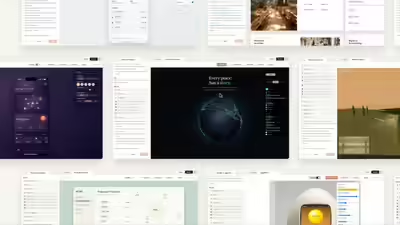
Adobe has already started integrating AI deeply into its own tools, even partnering with Claude itself to power creative workflows.
But now, Claude is stepping into their territory directly.
Even more intense industry reactions suggest this move is already shaking the market, with design platforms feeling the pressure as AI tools begin to replace traditional workflows.
Cross online communities, designers are raising concerns. Some worry that tools like this could undermine the value of design skills, making it easier for non-designers to produce work that once required training and experience. Others fear a future where speed replaces creativity, and originality gets lost in algorithm-generated outputs.
But not everyone sees it as a threat.
Some creatives are embracing it as a powerful assistant, a tool that can handle repetitive tasks, generate ideas, and speed up workflows. Instead of replacing designers, they argue, AI could amplify creativity, giving professionals more time to focus on high-level thinking and storytelling.
Still, the big question remains:
Where do you draw the line between tool and replacement?